
- Home
- 3D printed sex-specific medicines: Excipient-mediated modulation boosts systemic drug exposure by more than three-fold in male rats
- 3D printed sex-specific medicines: Excipient-mediated modulation boosts systemic drug exposure by more than three-fold in male rats
3D printing is opening new possibilities for personalised medicine, but what if medicines could be tailored not just to individuals, but to fundamental biological differences such as sex?
In this study, we challenge a long-standing assumption that pharmaceutical excipients are biologically inert. Instead, we demonstrate that excipients can actively influence drug absorption in the body and, crucially, that these effects can differ between males and females.
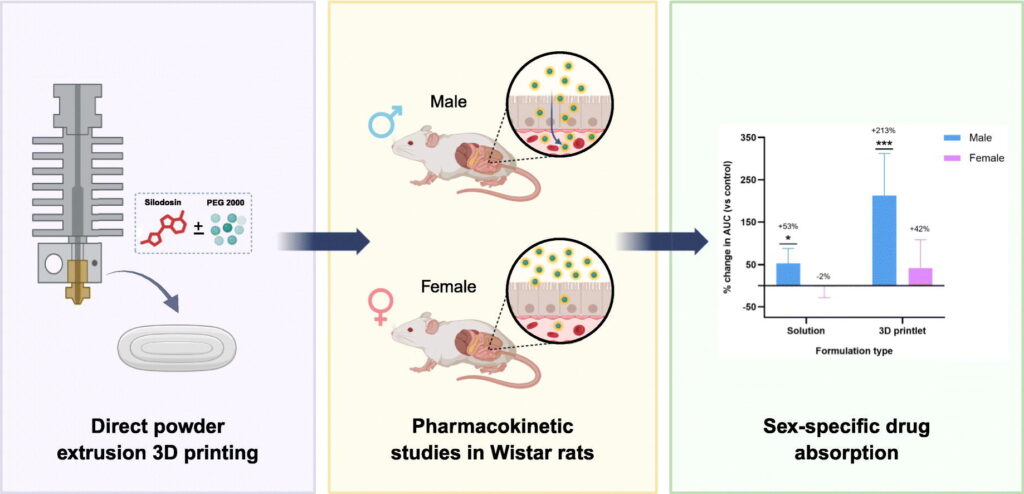
Using silodosin as a model drug, this study investigated polyethylene glycol (PEG 2000), an excipient known to interact with intestinal transporters. We found that PEG 2000 significantly increased drug exposure in male rats, while having little to no effect in females. When incorporated into 3D printed tablets (“printlets”) produce by direct powder extrusion (DPE), this led to striking sex difefrences, resulting in a 213% (more than three-fold) increase in drug exposure in males, but not in females.
These findings demonstrate the feasibility of integrating functional excipients into 3D printed dosage forms to improve the oral bioavailability of drugs with transporter-limited absorption. By strategically adjusting excipient concentration, drug absorption can be modulated in a sex-specific manner, enabling reduced drug doses, lower API load, and improved formulation efficiency. By leveraging low-cost, readily available off-the-shelf excipients, this innovative approach represents a novel, more economical and sustainable strategy for drug development.
Read the full article here.