
- Home
- A Novel Semi-Automated Pipeline for Optimizing 3D-Printed Drug Formulations
- A Novel Semi-Automated Pipeline for Optimizing 3D-Printed Drug Formulations
3D printing has enormous potential for producing personalised medicines, but developing printable drug formulations remains a major challenge. Currently, scientists often rely on trial-and-error experimentation to design formulations and determine printing parameters, a process that can take weeks and requires significant expertise and resources.
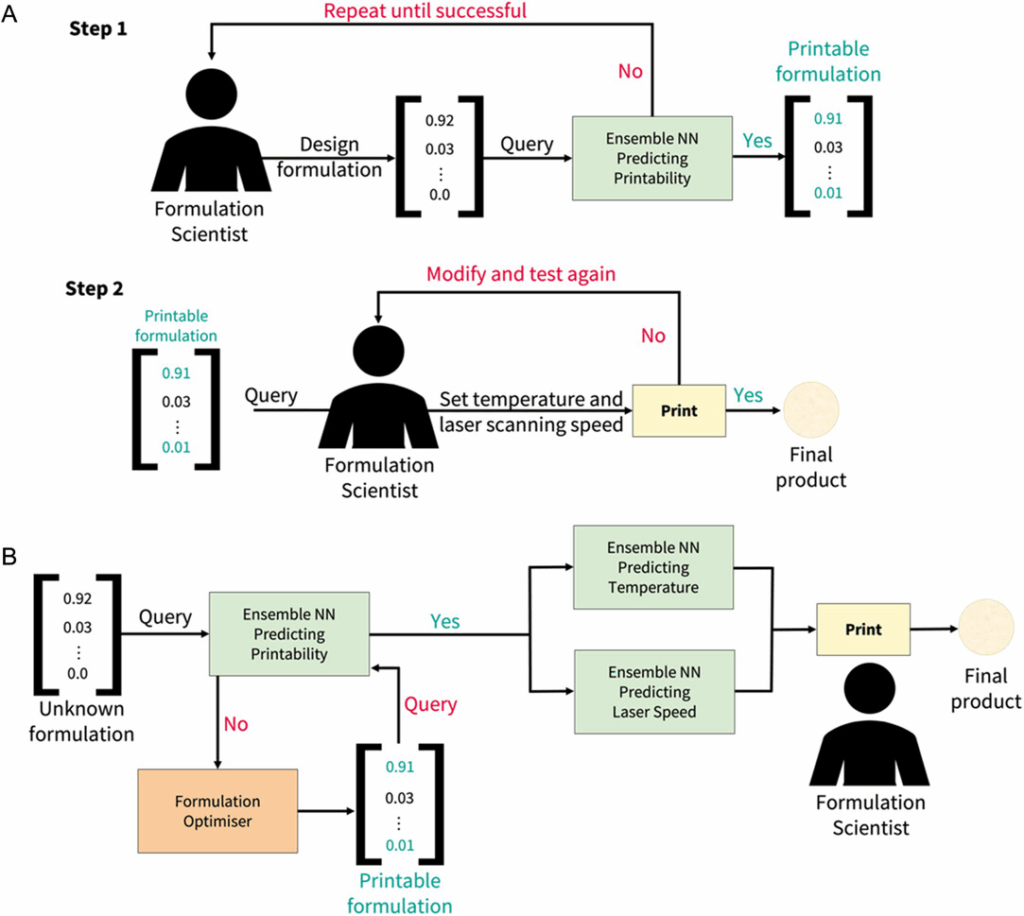
In this study, we developed a semi-automated pipeline powered by artificial intelligence to streamline this process for selective laser sintering (SLS) 3D printing. The system combines an optimisation algorithm with deep learning models that can automatically generate printable drug formulations and predict the optimal printing conditions, such as temperature and laser scanning speed.
The pipeline works by iteratively modifying formulations and evaluating their predicted printability using neural networks. Once a suitable formulation is identified, the model predicts the printing parameters required for successful manufacturing. This approach removes much of the manual trial-and-error process, leaving scientists responsible only for the final formulation preparation and printing step.
When tested experimentally, 80% of the generated formulations were successfully printed, and the predicted printing parameters achieved 92% accuracy. Importantly, the entire process, from formulation design to printing, could be completed within a single day, dramatically accelerating the development of 3D-printed medicines.
Overall, this work demonstrates a powerful new approach for automating the design of 3D-printed drug formulations, bringing the field closer to faster, more efficient, and scalable production of personalised medicines.
Find out more here.