
- Home
- 3D printing personalized medications in a hospital: Rapid and non-destructive dose verification of printed medicines enabled by miniaturised spectroscopy
- 3D printing personalized medications in a hospital: Rapid and non-destructive dose verification of printed medicines enabled by miniaturised spectroscopy
3D printing is rapidly reshaping how medicines can be made, especially when it comes to personalisation and on-demand production in hospitals. Instead of relying solely on large, centralised factories, pharmaceutical 3D printing opens the door to decentralised manufacture right at the point of care. But for this vision to work in real clinical settings, one key piece has to fall into place: fast, reliable quality control that does not destroy the medicine being tested.
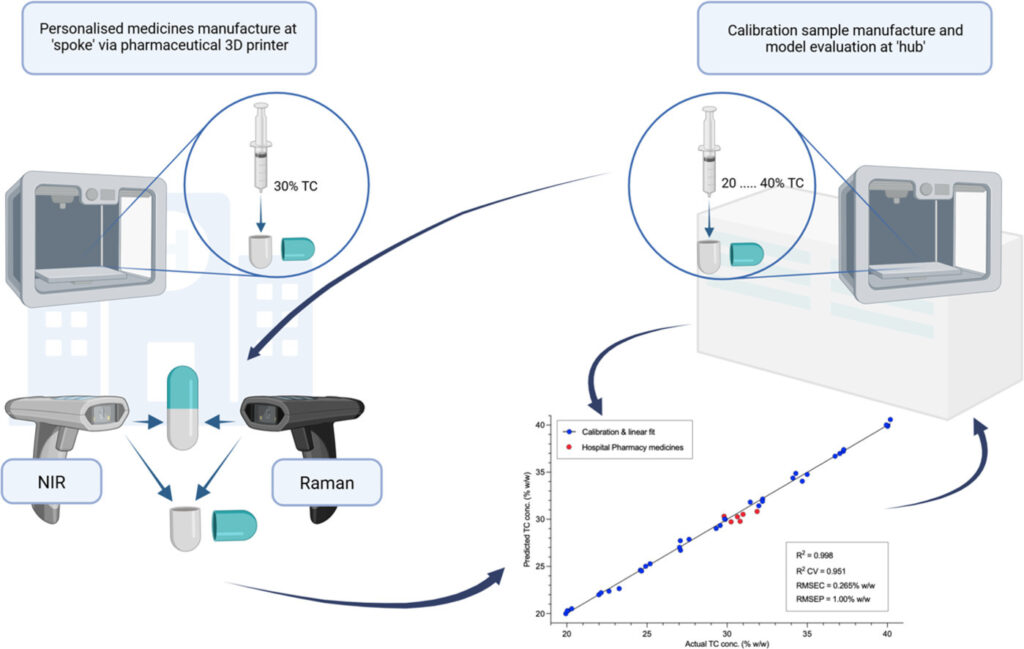
This study explored exactly that challenge in a real hospital environment. For the first time, we evaluated two miniaturised, handheld spectroscopic devices, near-infrared (NIR) and Raman, for non-destructive quality control of 3D printed medicines directly in a hospital pharmacy, the point of manufacture. The drug in question was tamoxifen, a widely used cancer therapy, produced in the hospital pharmacy of Gustave Roussy Cancer Campus during preparation for a clinical trial.
A clever “hub-and-spoke” model underpinned the work. Calibration samples were manufactured in a research setting (the hub), while spectral measurements and validation were carried out in the hospital pharmacy (the spoke), using the same materials and suppliers. This approach mirrors how decentralised manufacturing could realistically operate, with robust methods developed centrally and deployed locally.
Both handheld devices performed well. Accurate chemometric models were built to quantify tamoxifen content, whether spectra were collected directly from open capsules or through closed capsule shells. In each case, the methods were rapid, accurate, and entirely non-destructive, making them ideal for small-batch, patient-specific medicines.
The study shows that compact NIR and Raman analysers can support safe, efficient quality control of 3D printed medicines in hospital pharmacies. It also highlights how hub-and-spoke model development could accelerate the wider adoption of decentralised pharmaceutical manufacturing, with future choices between technologies shaped by cost, integration, and practical deployment.
Read the full article here.