
- Home
- Enabling the personalisation of 3D printed extended-release oral drug products: Transmission Raman spectroscopy as a rapid quality control tool
- Enabling the personalisation of 3D printed extended-release oral drug products: Transmission Raman spectroscopy as a rapid quality control tool
Personalised medicines are edging closer to everyday clinical reality, and 3D printing is one of the technologies making that possible. In the UK, new legislation now allows decentralised manufacture of medicines, meaning tablets can be produced closer to the patient, in small batches and tailored doses. But with that flexibility comes a big challenge: how do you reliably check the quality and dose of each tablet without slowing everything down or destroying the product in the process?
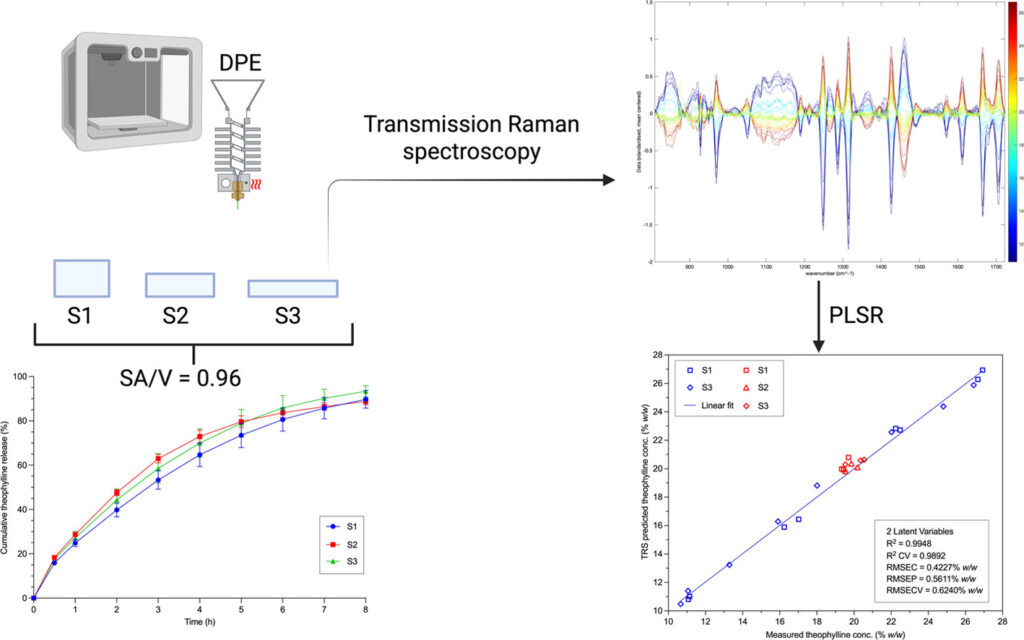
The work described here tackles that problem head-on. We demonstrated, for the first time, a fast, non-destructive way to measure drug content in individual 3D-printed tablets, known as “printlets”, using Transmission Raman Spectroscopy (TRS). Unlike traditional quality control methods, which often require tablets to be crushed and analysed, TRS can “see” through the entire tablet and quantify how much drug is inside without damaging it.
To put the method to the test, we developed a simple theophylline-based formulation suitable for direct powder extrusion 3D printing. They printed extended-release tablets in three different sizes, carefully designed to have the same surface area-to-volume ratio so that drug release would be consistent regardless of dose. Dissolution testing confirmed this worked: all tablet sizes showed equivalent extended-release profiles and met pharmacopeial standards.
The real breakthrough came with the data analysis. By combining TRS with partial least squares regression, we developed a model calibrated using only the smallest and largest tablets. That model accurately predicted drug content across all sizes, with excellent agreement compared to the conventional reference method.
Together, these results position TRS as a powerful quality control tool supporting decentralised, personalised medicine manufacturing using 3D printing, bringing us one step closer to safe, flexible, and on-demand drug production.
Read the full article here.